
One platform. Every organization isolated.
SIEM, vulnerability management, penetration testing, threat intelligence, incident response and NIS2 reporting in one place. Each organization lives in its own database schema, every containment action needs a second person, and every step is kept as evidence.
- 19scan runners
- 24hNIS2 early warning, tracked on the incident
- 1schema per organization, proven by a test
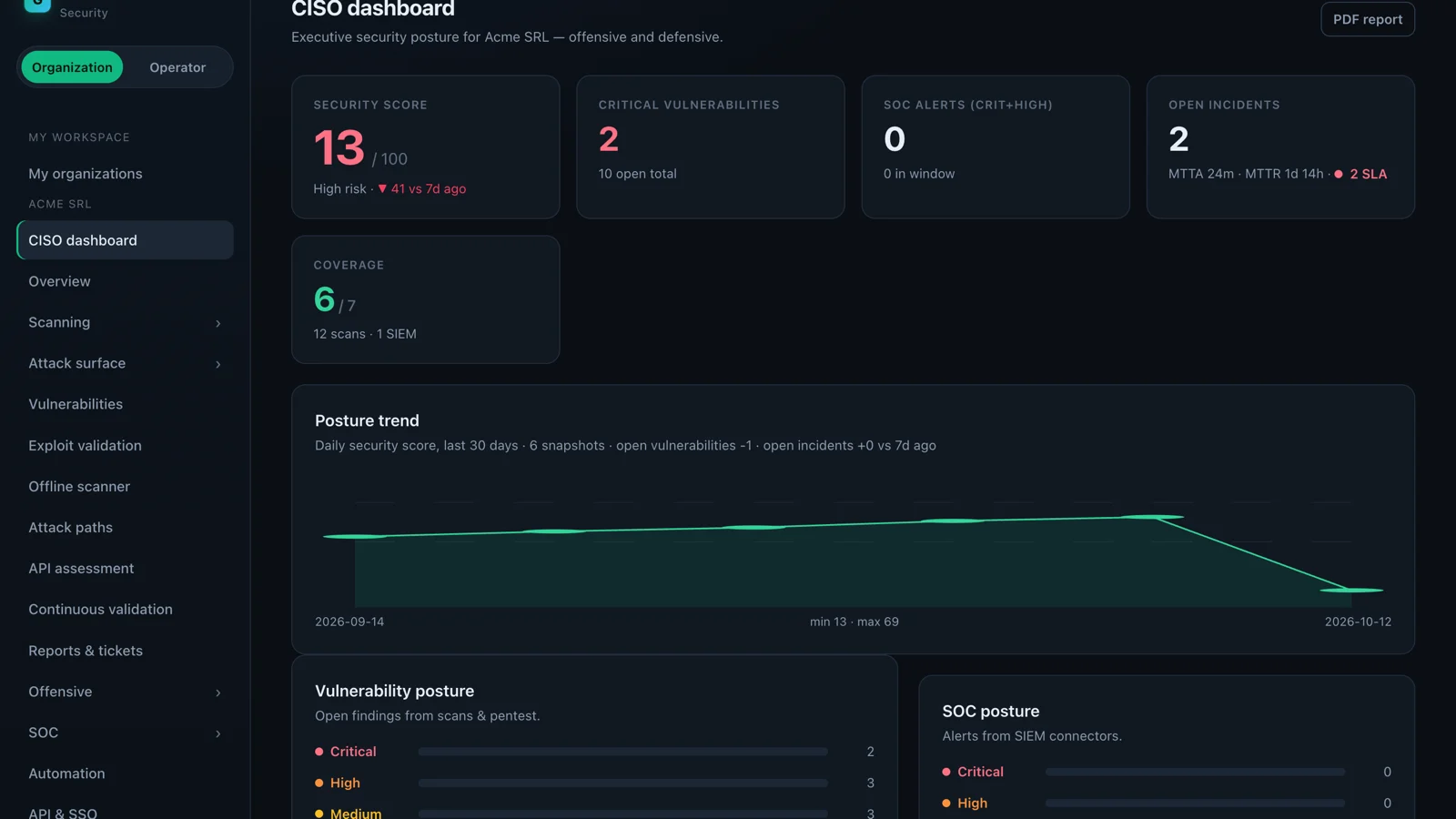
Built by a team that operates security, not by a vendor.
GPSS has been running monitoring, vulnerability management and penetration tests for Romanian and European organizations for years. GPSS ONE is the platform that grew out of that work. It keeps the SIEM, EDR and ticketing system you already pay for and adds the engine, the guardrails and the proof.
SIEM
Events are normalized to OCSF and matched against Sigma rules. Rules can be staged in shadow mode and reloaded without restarts. Alerts are correlated into incidents by attacker, host and campaign, and UEBA baselines flag unusual hosts and users after a 14-day learning window.
- Ingest: Wazuh, Palo Alto, Fortinet, syslog, CEF, JSON
- Per-tenant event store, forensic search, retention you set
Incidents and response
Incidents carry tasks, participants, evidence with SHA-256 and an audit chain. Playbooks branch on conditions, expire on a TTL, roll back and verify their effect. The visual designer validates and simulates a playbook before it runs.
- Isolate a host, disable an account, block an IP, revoke sessions
- Approval by a second person, with re-authentication
Vulnerability management
External surface, cloud (Prowler), Kubernetes posture, container images (Trivy), source code (Semgrep) and dependencies. Findings get a CWE, OWASP and MITRE mapping, CVSS v3.1 and v4.0, EPSS and CISA KEV, and a priority from 0 to 100 that explains itself.
- Deduplication, triage, SLA and tickets with automatic re-test
- Export to CSV and SARIF
Penetration testing
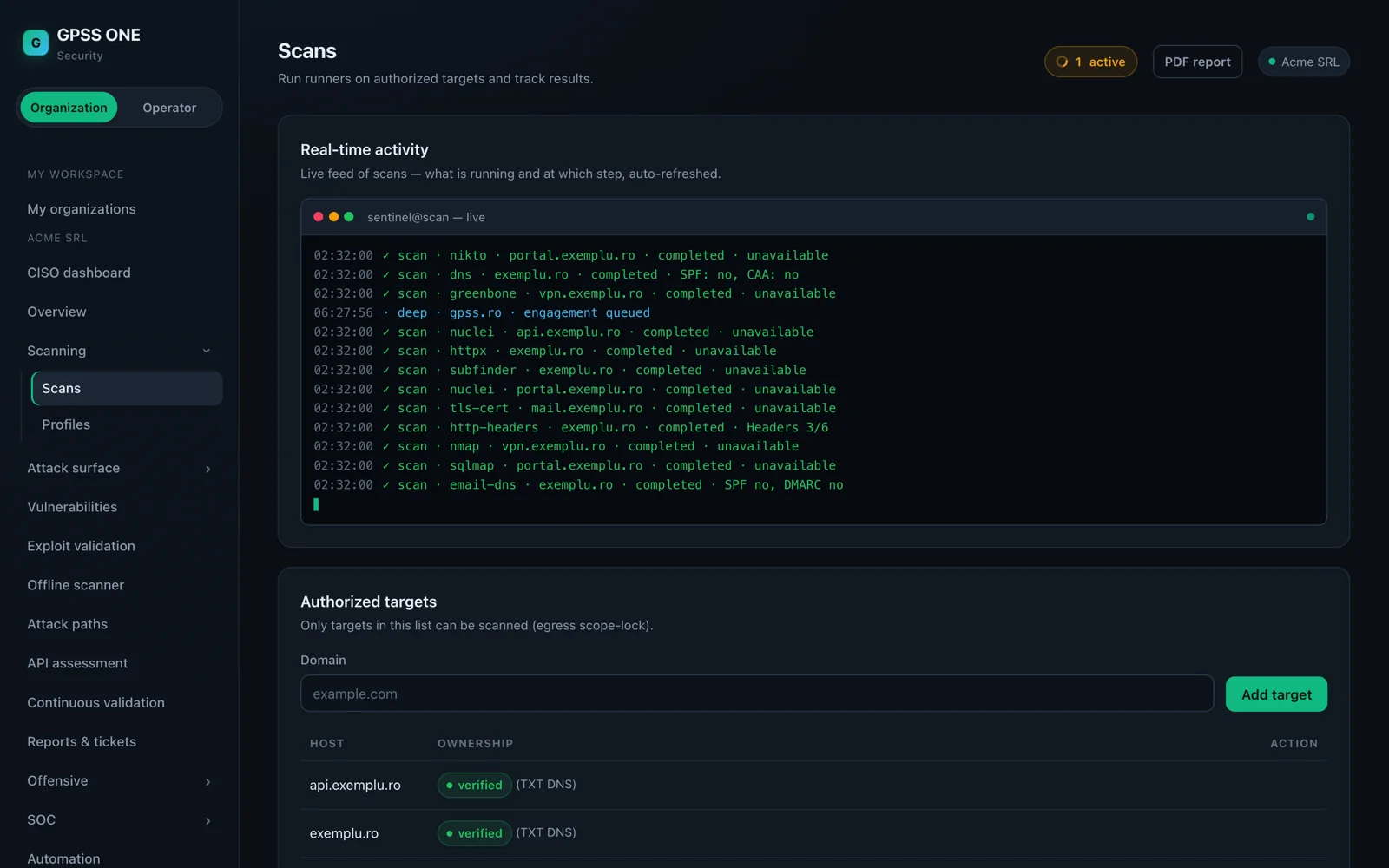
Safe probes confirm whether a finding is exploitable and keep the evidence. Multi-stage engagements, OpenAPI and GraphQL assessment with nine non-destructive checks, and continuous validation campaigns that compare each run with the last and score your controls.
- Ownership verified by DNS record or signed agreement before any scan
- Offline scanner for isolated networks, with Ed25519-signed data packages
Threat intelligence
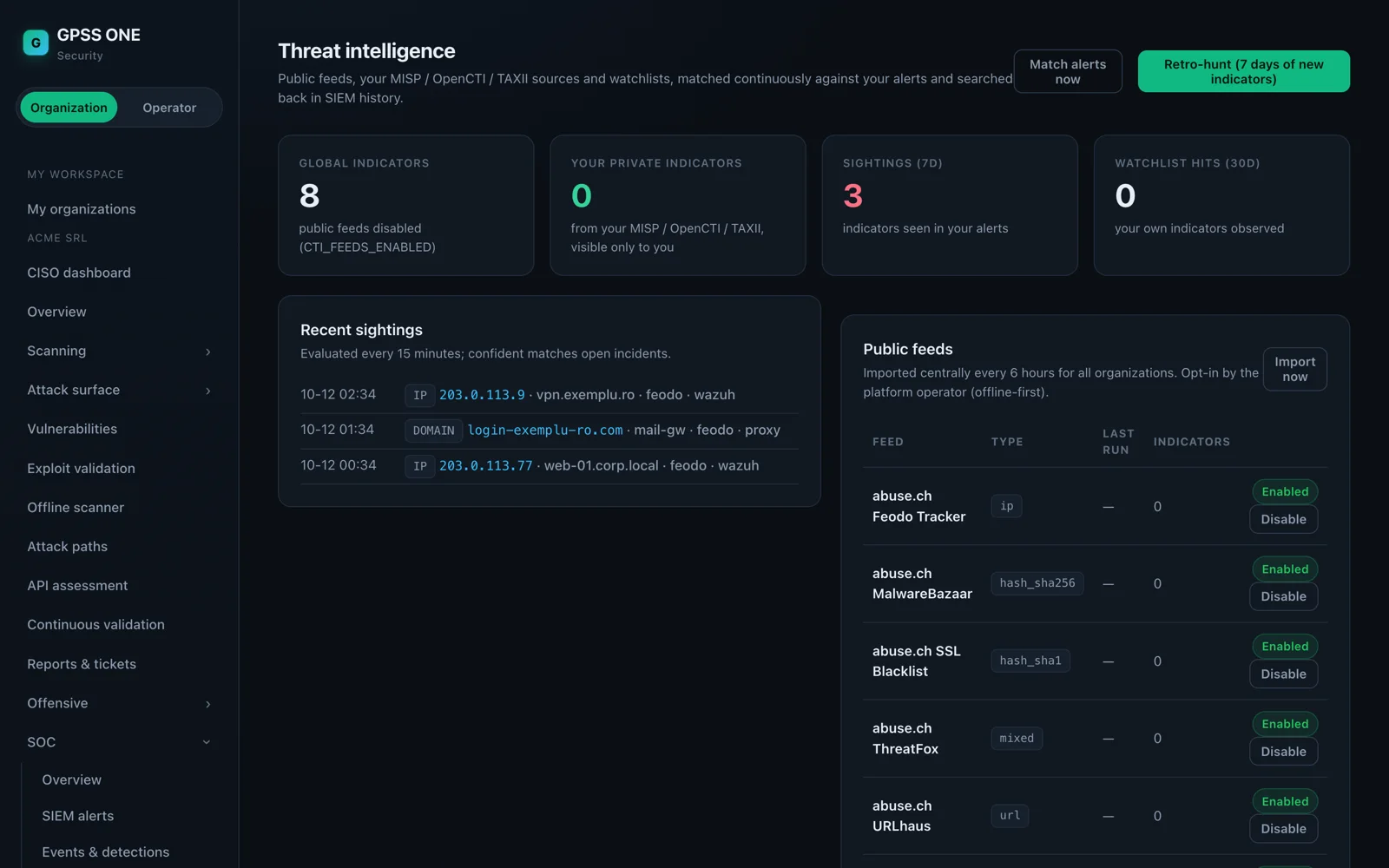
MISP, OpenCTI and TAXII 2.1 in both directions, OTX, GreyNoise and Shodan, public feeds from abuse.ch, OpenPhish, Spamhaus and Tor. Private indicators and watchlists per organization, sightings every 15 minutes, 30-day retro-hunt in the SIEM, and a STIX 2.1 graph you can export as a bundle or serve over your own TAXII server.
- Indicators enriched inside every incident
Compliance, on-call, reports
NIS2 article 23 notifications with PDF and JSON export. On-call schedules with rotation and escalation; paging by e-mail, Telegram, Signal, Slack, Teams, SMS, voice or ntfy, acknowledged from a signed link. Executive, technical and compliance reports, scheduled or on demand.
- Two-factor authentication: TOTP and passkeys; SSO over OIDC
- Signed SBOM, security.txt and CSAF advisories on the trust page
From alert to contained, with a second pair of eyes.
Alerts from your SIEM and from the built-in engine are correlated into incidents. A playbook proposes the containment; a second person with the right role approves it after re-authenticating; the connector executes it through CrowdStrike, SentinelOne, Microsoft Defender, Entra ID, Keycloak, Active Directory, Cloudflare or pfSense; the effect is verified and the whole chain is hashed.
See it on your own dataDetect
Sigma rules on normalized events, UEBA anomalies, CTI sightings every 15 minutes.
Verify
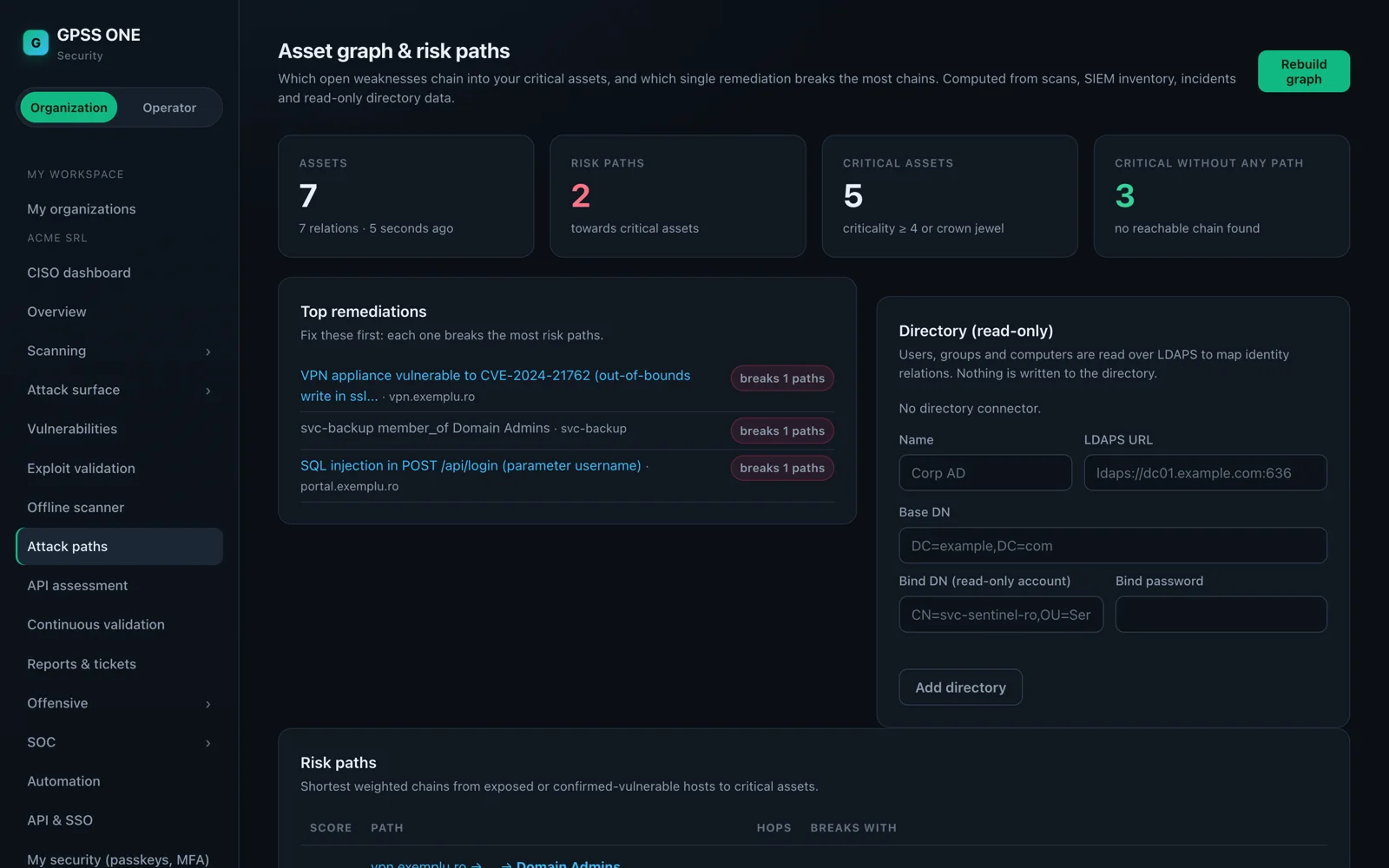
Safe probes confirm exploitability; the attack graph shows what the finding reaches.
Respond
Playbooks with TTL and rollback, executed only after four-eyes approval.
Prove
Audit chain, SHA-256 evidence, NIS2 notifications exported from the incident.
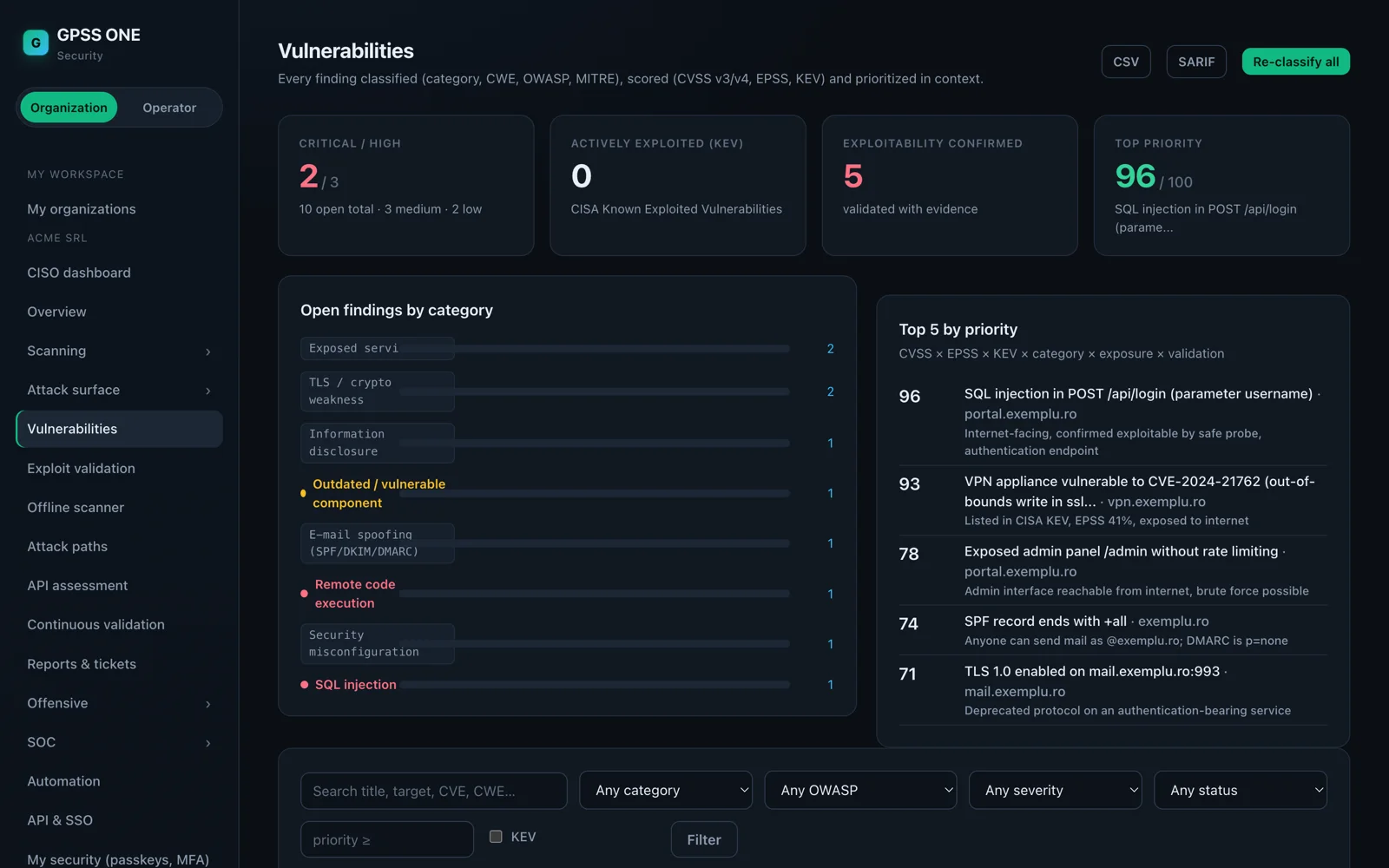
What a finding looks like
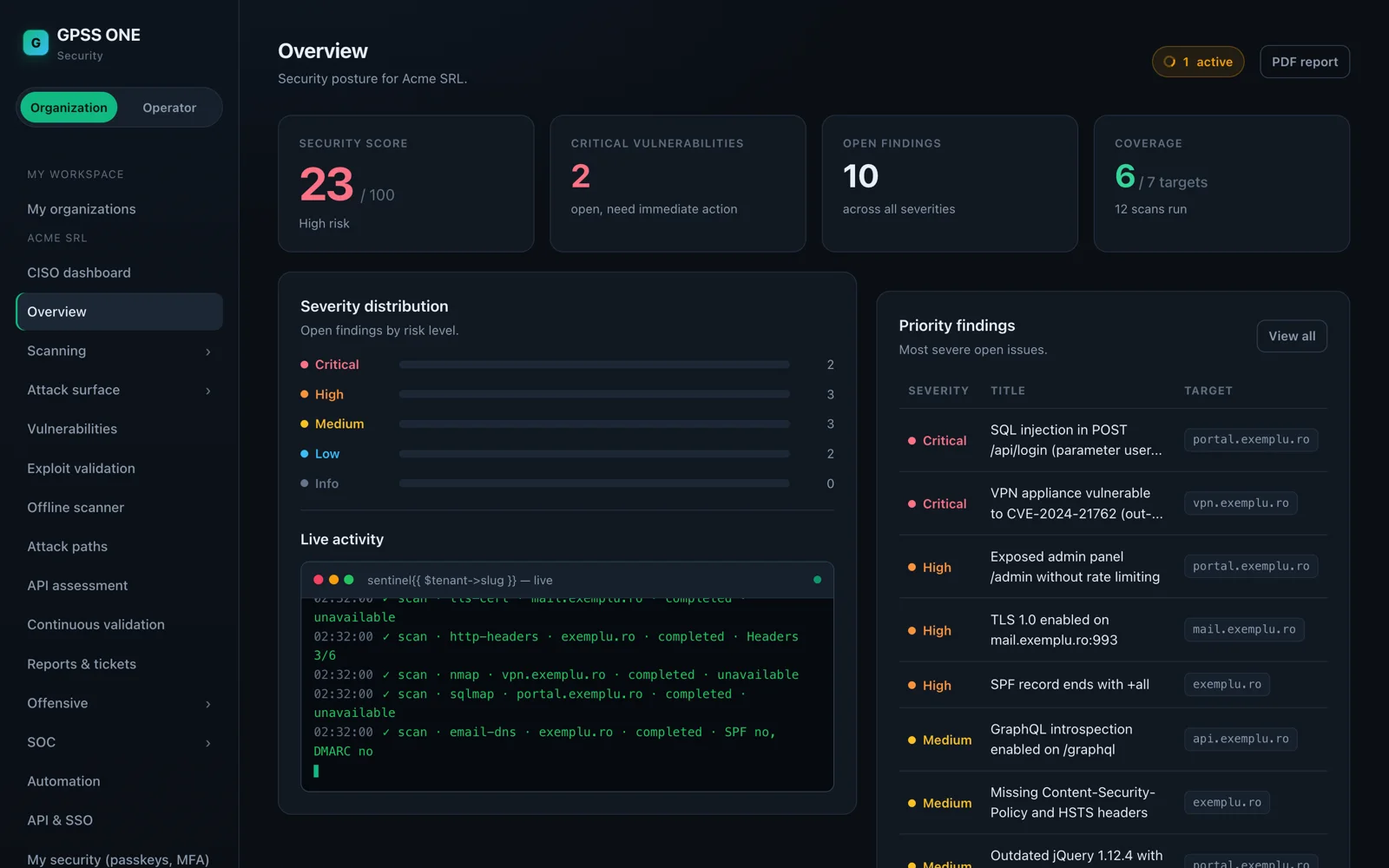
Each finding carries its category, CWE, OWASP and MITRE mapping, the CVSS and EPSS scores, whether it is in CISA KEV, and a priority from 0 to 100 with the reason written next to it. The screenshot is from a demo organization.
Compliance is part of the data model, not a report template.
The NIS2 reporting deadlines are fields on the incident. The approvals, the audit chain and the evidence hashes exist because an auditor will ask for them. For the Cyber Resilience Act we publish our own SBOM, security.txt and CSAF advisories, and sign releases, so the platform itself can be assessed as a supplier.
- NIS2 art. 23: 24h, 72h, 1 month, exported from the incident
- CRA: signed SBOM (CycloneDX), advisories (CSAF), update verification
- ISO 27001 and GDPR report mapping
- Schema per organization, verified by an automated test
- TOTP, passkeys, SSO (OIDC), separation of duties on approvals
- SaaS in the EU, on your infrastructure, or air-gapped
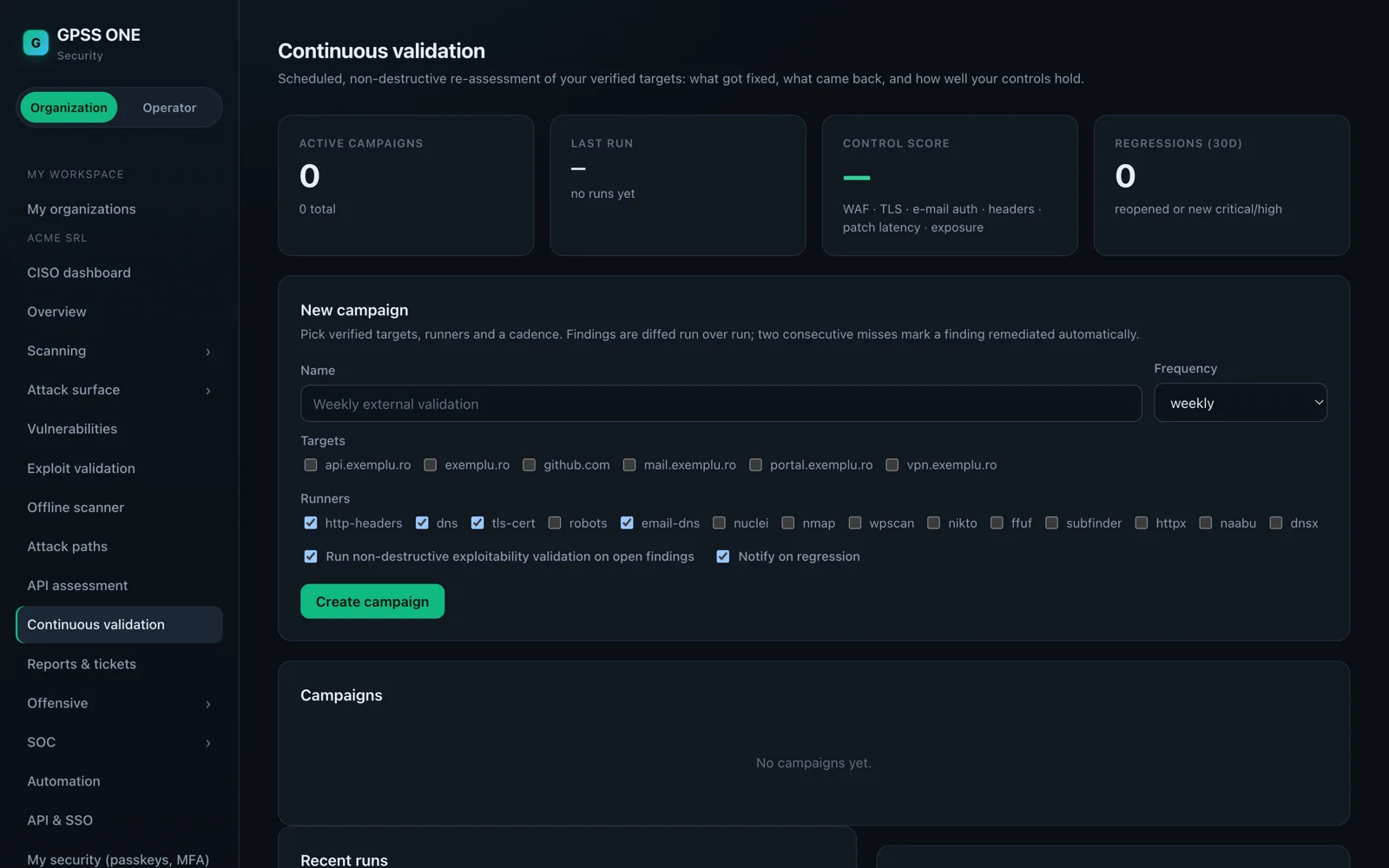
How teams use it.
Three situations we meet most often. The screenshots are from the same demo organization.
A NIS2 entity with a small IT team
A regional utility with two people in IT and no SOC. They forward firewall and Windows logs, connect Microsoft 365 and schedule a weekly external scan. Incidents open with the article 23 clock already running; the notification to the authority is exported as PDF from the incident itself. GPSS handles triage during business hours under a managed agreement.
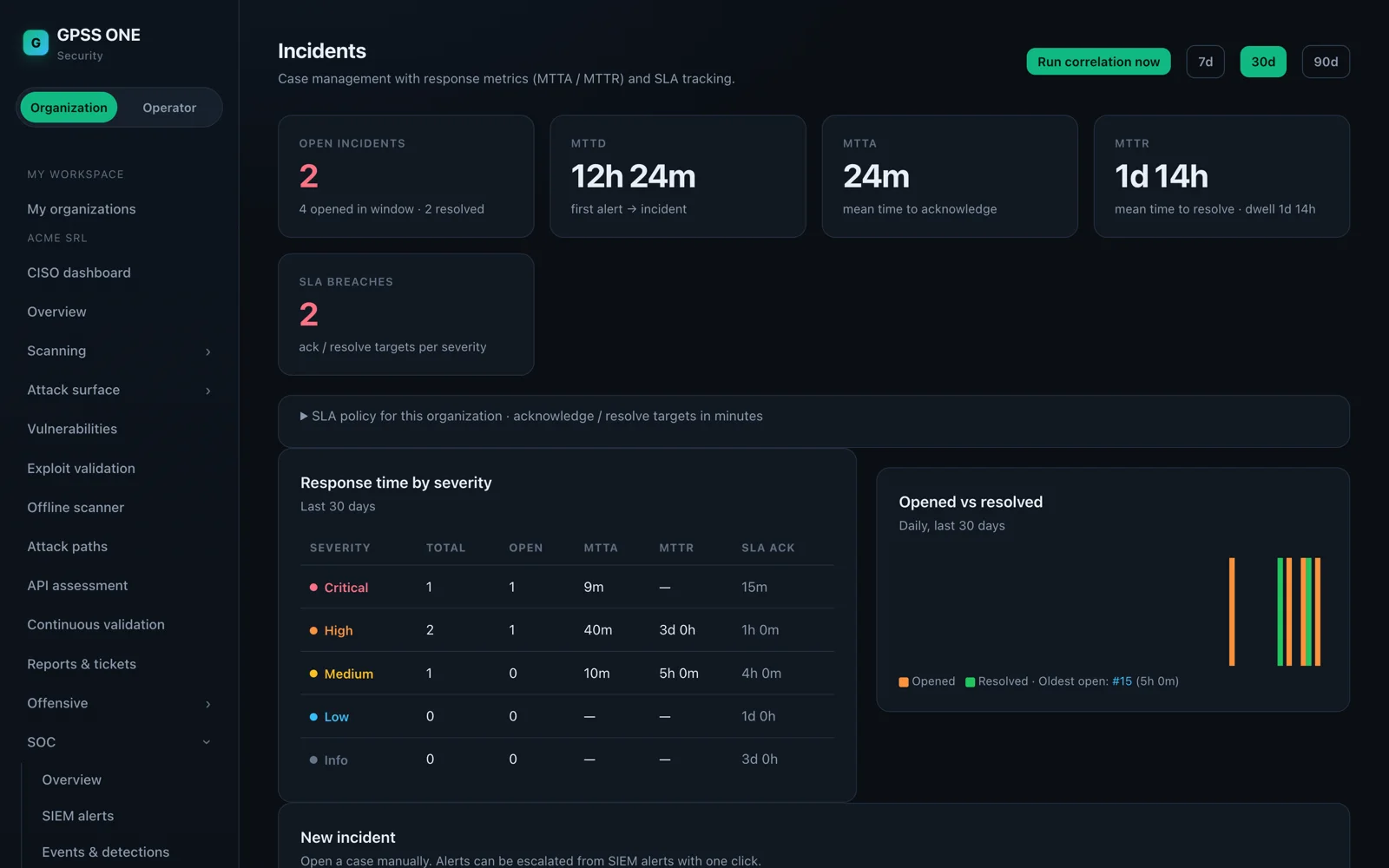
An MSSP with twenty clients
One operator console, each client in its own schema. OpenCTI and MISP are connected once by the operator and allocated to clients with read or read-write rights. Analysts work per client with per-client roles; the owner at the client approves containment. Reports go out monthly with the client's name on them.
A network with no internet access
Industrial site, isolated network. The offline scanner image is delivered on removable media with a signed package of CVE, KEV and EPSS data. It scans inside, signs the results, and the file is carried back and imported into the platform, where the signature and the scanner identity are verified before anything is shown.
What changed recently.
Operator-managed OpenCTI, MISP and TAXII sources can sit behind Cloudflare Access with a service token. Daily KEV import and SBOM audit scheduled.
Rules reload without restart and can run in shadow mode with metrics. The playbook designer validates and simulates a playbook before it runs; destructive operations require re-authenticated approval.
Indicators, actors and relationships as a STIX graph with bundle export and a TAXII server for sharing. Operator-managed CTI sources allocated per organization, synchronized every six hours.
TOTP and passkeys with an MFA policy per organization. Signed CycloneDX SBOM, security.txt, public trust page and CSAF advisories. Kubernetes posture against CIS and Pod Security Standards. OTX, GreyNoise and Shodan as intelligence sources.
Ingest with OCSF normalization and risk-based alerting, read-only XDR forensics, single sign-on over OIDC.
Assets from scans, SIEM inventory, incidents and a read-only directory connection; weighted shortest paths to critical assets. OpenAPI and GraphQL assessment. Validation campaigns with run-over-run diff, targeted re-test and control score.
Full history and advisories on the trust page. /trust